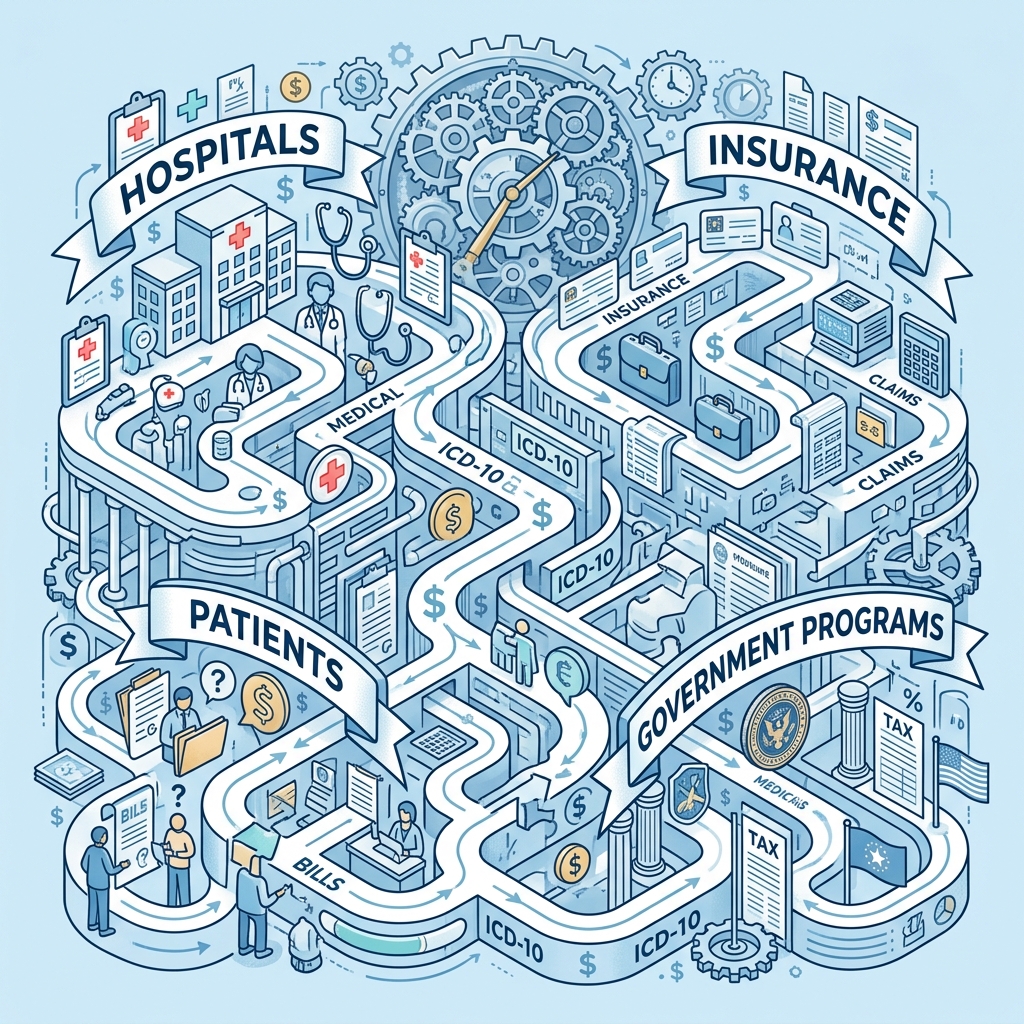
Hospital billing in the USA is a multi-step process involving hospitals, insurers, patients, and government programs like Medicare and Medicaid. Bills pass through coding, claims submission, insurance adjudication, and patient invoicing—each stage introducing potential errors and cost variations that patients can dispute or negotiate.
If you’ve ever opened a hospital bill and felt completely lost, you’re not alone. The United States healthcare billing system is widely considered one of the most complex in the world. A single overnight hospital stay can generate multiple bills from different providers, dozens of billing codes, and a final charge that looks nothing like what you expected to pay.
The stakes are high. According to a 2022 report by the Kaiser Family Foundation, roughly 100 million Americans carry medical debt—a figure that reflects not just the cost of care, but the difficulty patients face in understanding what they actually owe. Medical billing errors are also surprisingly common. A 2023 analysis by Medscape estimated that up to 80% of hospital bills contain at least one error.
Understanding how hospital billing works won’t make the system less frustrating—but it will give you the knowledge to navigate it, catch mistakes, and potentially save thousands of dollars. This guide breaks down every stage of the hospital billing process, from the moment you check in to the moment you pay your final balance.
Who Are the Key Players in Hospital Billing?
Hospital billing doesn’t involve just one party. It’s a web of organizations and individuals, each with a distinct role:
- Hospitals and providers: These are the entities delivering care and generating the initial charges. Hospitals set their own “chargemaster” rates—an internal price list that often bears little resemblance to what anyone actually pays.
- Insurance companies: Private insurers negotiate discounted rates with hospitals (known as contracted rates) and determine what portion of a bill they’ll cover.
- Patients: Responsible for the portion of costs not covered by insurance, including deductibles, co-pays, and coinsurance.
- Government programs: Medicare (for adults 65 and older) and Medicaid (for low-income individuals) set their own reimbursement rates, which are typically lower than private insurance rates.
- Medical billing companies: Many hospitals outsource their billing to third-party companies that handle coding, claims submission, and collections.
Each of these players interacts at different stages of the billing process, which is why the same hospital visit can result in multiple separate bills arriving at different times.
The Journey of a Hospital Bill: From Service to Statement
Understanding the lifecycle of a hospital bill helps explain why it takes weeks—or sometimes months—to receive one.
Step 1: Service documentation
The moment you receive care, every service, medication, test, and procedure is documented by clinical staff. This documentation forms the foundation of your bill.
Step 2: Medical coding
Coders translate clinical documentation into standardized codes. Two primary coding systems are used:
- ICD-10 codes (International Classification of Diseases): These describe diagnoses and conditions.
- CPT codes (Current Procedural Terminology): These describe procedures and services performed.
Coding accuracy is critical. A single digit entered incorrectly can result in a claim denial or a significantly inflated bill.
Step 3: Claims submission
Once coded, the hospital submits a claim to your insurance company (or to Medicare/Medicaid). The insurer then reviews the claim in a process called adjudication—checking whether the services are covered under your plan, whether prior authorization was obtained, and what the contracted rate for those services should be.
Step 4: Explanation of Benefits (EOB)
After adjudication, your insurer sends you an Explanation of Benefits—a document that outlines what was billed, what the insurer paid, and what you’re expected to pay. An EOB is not a bill, but it previews what’s coming.
Step 5: Patient statement
Once the insurer has processed the claim, the hospital bills you for the remaining balance. This is your official bill.
How to Decode Your Hospital Bill
Hospital bills are dense with terminology that most people have never been taught to read. Here are the key terms you’re likely to encounter:
- Chargemaster rate: The hospital’s list price before any insurance negotiation. Almost no one pays this rate.
- Contracted rate: The discounted rate your insurer has negotiated with the hospital.
- Allowed amount: The maximum your insurer will pay for a given service.
- Deductible: The amount you must pay out-of-pocket before insurance kicks in. In 2023, the average deductible for employer-sponsored health plans was $1,735, according to the Kaiser Family Foundation.
- Co-pay: A fixed fee you pay for a specific service (e.g., $30 for a specialist visit).
- Coinsurance: Your percentage share of costs after the deductible is met (e.g., 20% of the allowed amount).
- Out-of-pocket maximum: The cap on what you’ll pay in a given year. Once reached, insurance covers 100% of covered services.
If your bill lists only vague line items like “medical services” or “room and board,” you have the right to request an itemized bill—a detailed breakdown of every charge.
How Health Insurance Shapes What You Pay
Your insurance plan plays a massive role in determining your final bill. A few key factors:
In-network vs. out-of-network providers
Hospitals that have a contract with your insurer are considered “in-network.” Seeing an in-network provider means your insurer pays a contracted (lower) rate, and your cost-sharing is lower. Out-of-network providers can bill at much higher rates, and your insurer may cover less—or nothing at all.
One common and frustrating scenario: a patient goes to an in-network hospital but is treated by an out-of-network specialist (such as an anesthesiologist) without being told. Federal protections introduced by the No Surprises Act (2022) have addressed some of these situations, limiting out-of-network charges for emergency services and certain scheduled care.
Prior authorization
Many procedures require prior authorization—advance approval from your insurer before the service is performed. Without it, your insurer may deny the claim entirely. Always confirm authorization requirements before elective procedures.
Medicare and Medicaid: How Government Programs Affect Billing
For the 160 million Americans covered by Medicare or Medicaid, hospital billing follows different rules.
Medicare, administered by the federal government, reimburses hospitals at fixed rates based on diagnosis-related groups (DRGs). Hospitals are paid a predetermined amount for treating a specific condition, regardless of actual costs incurred. Medicare patients are still responsible for deductibles and co-insurance.
Medicaid, jointly funded by federal and state governments, provides coverage for low-income individuals and families. Reimbursement rates vary by state and are generally lower than both Medicare and private insurance rates. Eligibility rules and covered services also differ significantly from state to state.
Hospitals that treat a disproportionate share of low-income and uninsured patients may receive supplemental payments through the Disproportionate Share Hospital (DSH) program to offset the financial impact.
How to Dispute a Hospital Bill or Billing Error
Given the frequency of billing errors, reviewing your bill carefully isn’t paranoia—it’s prudent. Here’s how to approach a dispute:
- Request an itemized bill: Ask the hospital’s billing department for a line-by-line breakdown of every charge.
- Compare it to your EOB: Cross-reference what the hospital billed with what your insurer allowed and paid.
- Look for common errors: Duplicate charges, incorrect patient information, services never rendered, and upcoding (billing for a more expensive service than what was provided) are among the most frequent issues.
- File an appeal: If your insurer denied a claim you believe should be covered, file a formal appeal. The Affordable Care Act guarantees the right to appeal insurance denials.
- Contact your state insurance commissioner: If internal appeals fail, escalate to your state’s insurance regulatory body.
- Seek a patient advocate: Non-profit patient advocacy organizations and independent medical billing advocates can negotiate on your behalf, often on a contingency basis.
Practical Tips to Reduce Your Hospital Bills
Patients have more power than they often realize. These strategies can make a meaningful difference:
- Verify coverage before receiving care: Call your insurer and confirm that the hospital, surgeon, and any specialists are in-network.
- Ask for the cash price: Uninsured or underinsured patients can sometimes negotiate a lower rate by paying upfront in cash. The Hospital Price Transparency Rule (effective 2021) requires hospitals to publish standard charges publicly.
- Apply for financial assistance: Most non-profit hospitals are required by law to offer charity care programs. Ask the billing department about eligibility.
- Set up a payment plan: Hospitals generally prefer payment plans over unpaid debt. Negotiate terms directly with the billing department.
- Use a Health Savings Account (HSA): If you have a high-deductible health plan, an HSA allows you to pay qualified medical expenses with pre-tax dollars—effectively reducing your costs by your marginal tax rate.
What Does the Future of Hospital Billing Look Like?
Several trends are reshaping hospital billing in the United States.
Price transparency is accelerating. Following the Hospital Price Transparency Rule, the CMS (Centers for Medicare & Medicaid Services) has continued to strengthen enforcement, pushing hospitals to make negotiated rates publicly available. This is enabling new comparison tools that help patients estimate costs before receiving care.
Automated billing and AI are reducing coding errors. Hospitals are increasingly deploying AI-powered coding tools that improve accuracy and speed—potentially reducing the error rates that burden patients and providers alike.
Legislative reform remains an active area. Beyond the No Surprises Act, Congress continues to debate reforms targeting drug pricing, billing practices, and surprise medical bills in contexts not yet covered by current law.
Standardized billing formats are gaining traction. Proposals for simpler, more uniform billing statements aim to reduce patient confusion and administrative overhead simultaneously.
Take Control of Your Medical Bills
Hospital billing in the USA is genuinely complex—but it’s not impenetrable. Knowing the key players, understanding the lifecycle of a claim, and recognizing your rights as a patient puts you in a much stronger position to catch errors, reduce costs, and navigate disputes effectively.
The most important habit to develop: don’t pay a hospital bill without reviewing it carefully first. Request the itemized version, compare it to your Explanation of Benefits, and don’t hesitate to ask questions. Hospitals expect negotiation more than most patients realize.
Medical debt affects millions of Americans, but a meaningful portion of that burden stems from errors and misunderstandings that are entirely correctable. Knowledge, in this case, is genuinely one of your most valuable tools.
Frequently Asked Questions
Why do I receive multiple bills after a single hospital visit?
Different providers involved in your care—such as the hospital, the attending physician, the anesthesiologist, and radiologists—often bill separately. Each is typically an independent contractor rather than a hospital employee, meaning each sends their own invoice.
What should I do if I can’t afford my hospital bill?
Contact the hospital’s billing department immediately. Most non-profit hospitals offer financial assistance or charity care programs based on income. You can also negotiate a payment plan or request a reduction in charges. Paying a reduced amount upfront is often preferred by hospitals over sending debt to collections.
How long does a hospital have to send me a bill?
There is no single federal law governing this. Most states allow hospitals several years to bill patients, though the typical timeframe is within 90 to 180 days of service. Check your state’s statutes of limitations on medical debt for specifics.
What is the No Surprises Act, and does it protect me?
The No Surprises Act, which took effect in January 2022, protects patients from unexpected out-of-network bills for emergency services and certain non-emergency care at in-network facilities. It limits what out-of-network providers can charge to the in-network cost-sharing amount in these situations.
Can I negotiate a hospital bill after it’s already been sent to collections?
Yes. Even after a bill is sent to a collections agency, you can negotiate a settlement—often for significantly less than the original balance. Get any agreement in writing before making a payment.
What is an Explanation of Benefits, and is it the same as a bill?
An Explanation of Benefits (EOB) is a document from your insurer summarizing how a claim was processed. It shows what was billed, what the insurer paid, and what you owe—but it’s not a bill. Your actual bill comes from the hospital or provider directly.